21
What do the writers express with this question?

Concern about the public’s lack of interest in the activities of conservation organisations.

Doubt whether the approach of conservation organisations to nature is altogether right.

Surprise at people giving such generous financial aid to conservation organisations.
22
What is the purpose of paragraph 2?

To applaud the growing recognition of the need for conservation.

To describe the form conservation has taken so far.

To illustrate the worldwide approval of Western conservation methods.

To stress the limited success of the current conservation policy.
23
What is the example of ‘Africa’ (line 39) meant to illustrate?

Most national parks are set up in thinly populated areas.

National parks generally compensate local people for damage done to their property.

National parks usually cover very large stretches of land.

The creation of national parks has robbed a great many people of their land and
livelihood.
24
What is suggested in lines 53–66 (‘It is … imagination.’)?

All unspoilt areas of land should be protected against any intruders.

Even supposedly unspoilt areas have at one time been cultivated in some way.

Rainforests are steadily giving way to farmland.

The idea that nature can be protected is an illusion.
25
What is the example of the ‘Masai’ (line 75) meant to illustrate?

Banning natives from their land for the purpose of conservation may be
counterproductive.

It is difficult to restore cultivated land to its former natural state.

The absence of native people may make parks less attractive to tourists.

Wildlife often increases in areas that people have been forced to leave.
26
What conclusion does paragraph 6 lead up to?

Countries invest far more money in their defence than in environmental protection.

Some original landscapes are destroyed by freedom movements.

The methods used by environmental campaigners are becoming more and more violent.

Vast amounts of conservation money go to policing the nature reserves.
27
What distinguishes the ‘alternative vision’ (line 109)?
According to this vision,

conservation policies should be different from area to area.

man is not free to adjust his natural surroundings to his needs.

modern methods of cultivating the land can be environment-friendly.

the presence of people can be beneficial to both man and nature.
28
How could the sentence ‘Community … professionals.’ (lines 120–126) also begin?

For example, community…

One way or another, community…

On the other hand, community…

To begin with, community…
29
How do paragraphs 8 and 9 relate to paragraph 7?

They prove the plan proposed in paragraph 7 to be impractical.

They shed new light on the point made in paragraph 7.

They tone down the optimism expressed in paragraph 7.
30
Which of the following is true of the ‘conservation professionals’ discussed in the last
paragraph?

They act as if they know better than the local people.

They concentrate on the specific needs of the local people.

They disagree on what constitutes the best approach to conservation.

They do not have the interests of conservation organisations at heart.
31
Which of the following is in line with the writers’ ideas about conservation?

The ‘powerful ideology’ discussed in paragraph 3.

The ‘alternative vision’ discussed in paragraph 7.

The view of the ‘conservationists’ discussed in paragraph 8.

The view of the ‘conservation professionals’ discussed in paragraph 9.
 What is the main point made in this article?
 allowed black people to be elected to the Senate.
 enforced laws against racial discrimination.
 made it officially illegal to keep slaves.
 publicly acknowledged Abe Lincoln’s historical importance.
 modernise
 promote
 protect
 standardise
 convenient for
 superior to
 unsuitable for
 fewer changes
 greater satisfaction
 less trouble
 more anxiety
 people’s interests
 politicians’ mistakes
 the larger issues
 the minor problems
 improves
 protects
 reveals
 threatens
 Brussels
 campaigners
 the government
 the police
 leave me cold
 make me laugh
 mean a lot to me
 take me by surprise
 by the way
 for example
 therefore
 contrast with
 interest in
 link with
 longing for
 exciting
 outdated
 practical
 safe
 What is the main function of the examples in lines 4–14 (‘I have … continuing.’)?
 are willing to take informal personality tests, no matter how absurd.
 believe that informal personality tests can be useful.
 consider informal personality tests to be a waste of time.
 What recent development does the writer sketch in the second paragraph?
 Employers applying amateur psychology to improve working conditions.
 People needing psychology games to give shape to their lives.
 The use of popular psychology in employment settings.
 The waste of working hours spent on computerised psychology games.
 What feeling does the writer express in the third paragraph?
 Amusement.
 Approval.
 Doubt.
 Surprise.
 What can be concluded from lines 47–62 (‘Psychometric … selections.’) about
 It can only be done with the help of multiple choice questions.
 It has many advantages but has met with a lot of criticism.
 It is an effective way of improving the quality of top executives.
 It is widely applied in Britain and can have profound consequences.
 ‘Anglian Water’ (lines 71–72) is facing an industrial tribunal because it is accused of
 conducting tests without the help of experts.
 firing people on the basis of irrelevant tests.
 putting staff through tests without telling them about the possible consequences.
 threatening to dismiss employees who were unwilling to take a test.
 How should Roy Davies’ words in lines 85–92 be interpreted?
 As a recommendation of his own company’s tests.
 As arguments against the use of tests to sack people.
 As evidence of the uselessness of all psychometric tests.
 As opposition to Anne Vinden’s opinion about tests.
 How could the sentence starting with ‘Dr Steve Blinkhorn’ (line 104) also begin?
 For example, Dr Steve Blinkhorn…
 However, Dr Steve Blinkhorn…
 Moreover, Dr Steve Blinkhorn…
 Therefore, Dr Steve Blinkhorn…
 Which of the following statements about psychometric testing is/are true, according to
 Both 1 and 2 are true.
 Neither 1 nor 2 is true.
 Only 1 is true.
 Only 2 is true.
 What is the function of paragraph 9?
 To illustrate that children start playing psychology games at an early age.
 To round off the article in a light-hearted way.
 To warn that the results of psychological tests should not be taken literally.
 How are Harry Lime’s words ‘In … clock.’ (lines 2–4) to be understood in the context of
 As a compliment on the technological achievements of the Swiss.
 As a light-hearted criticism of the lack of originality of the Swiss.
 As a mocking comment on Switzerland’s reputation of innocence.
 As a recommendation of Switzerland’s form of government.
 What is ‘the inescapable conclusion of a study of secret documents’ (lines 8–9)?
 Nazism was more widespread in Switzerland than has so far been assumed.
 Switzerland profited substantially from the Nazi plundering of Europe.
 The Swiss authorities and banks did their best to oppose the Nazi regime.
 How are the Swiss characterised in paragraph 3?
 As eager to restore the injured image of their banks.
 As reluctant to set right their wartime wrongdoings.
 As still discriminating against Jewish institutions.
 As unprepared to give up their connections with former Nazi clients.
 Which of the following becomes clear from paragraph 4?
 A lot of hard drugs are distributed via Switzerland.
 Switzerland is still allowing its banks to conceal crime-related money.
 The Swiss government is trying to stop illegal banking practices in the country.
 Which of the following does the writer plead for in the last paragraph?
 Britain should admit that, like Switzerland, it has banks that hide criminal money.
 Britain should stimulate further research into any dubious dealings by Swiss banks.
 Britain should support Switzerland in paying back damages to victims of the Second
 Britain should urge Switzerland to be absolutely open about its banking practices.
 How does the writer introduce the topic of the article in paragraph 1?
 By indicating what makes a best-selling album.
 By mentioning the three most popular LPs ever.
 By paying attention to one particularly successful album.
 By praising the good old days of pop music.
 Why was nobody counting album sales?
 no reliable method for registering record sales existed.
 pop artists hardly ever recorded long-playing records.
 relatively little money was made from the sale of albums.
 the success of pop groups was not measured by sales figures.
 How could the sentence ‘Two … schedule.’ (lines 19–25) also begin?
 By the way, two…
 However, two…
 In fact, two…
 Moreover, two…
 The word ‘guesstimates’ (line 30) is in line with
 ‘everybody assumed that it would be a bestseller’ (lines 3–4).
 ‘exactly how well wasn’t known for sure’ (lines 12–13).
 ‘Albums were still considered something of a sideline.’ (lines 17–19).
 ‘there has never been much doubt’ (lines 31–32).
 What conclusion does paragraph 4 lead up to?
 Oasis’ best songs are inspired by the Beatles.
 Oasis’ popularity fits in with the great British tradition in pop music.
 Oasis’ second album may well become the best-selling album ever.
 Oasis’ success is not likely to last as long as that of the Beatles.
 What does paragraph 5 suggest about many ‘monster-selling albums’?
 having been available for a long period of time.
 having been bought twice by the same people.
 new rules being used for composing pop charts.
 smart promotion techniques being used.
 Which of the following statements is/are true, according to lines 56–64 (‘When … Glory?’)?
 Both 1 and 2 are true.
 Neither 1 nor 2 is true.
 Only 1 is true.
 Only 2 is true.
 What conclusion is to be drawn from lines 65–76 (‘In … Dire Straits.’)?
 Oasis’ rock music has been adapted to suit the taste of the masses.
 Oasis should try to promote their albums more effectively.
 The sort of music Oasis make does not usually achieve enormous sales.
 What does the writer suggest with the words ‘Oasis would, certainly.’ (lines 83–84)?
 be as popular as Phil Collins and Elton John if they were less rebellious.
 consider themselves less acceptable to a wide public than Phil Collins and Elton John.
 like to earn as much as Phil Collins and Elton John.
 sing as well as Phil Collins and Elton John if they could.
 What is the point made in paragraph 8?
 Pop groups apparently need a lot of creativity to remain popular in the long run.
 Pop groups should take care to seek publicity all the time.
 Showmanship can serve as a means to cover up poor quality.
 Showy presentation appears to be the key to ultimate success in pop music.
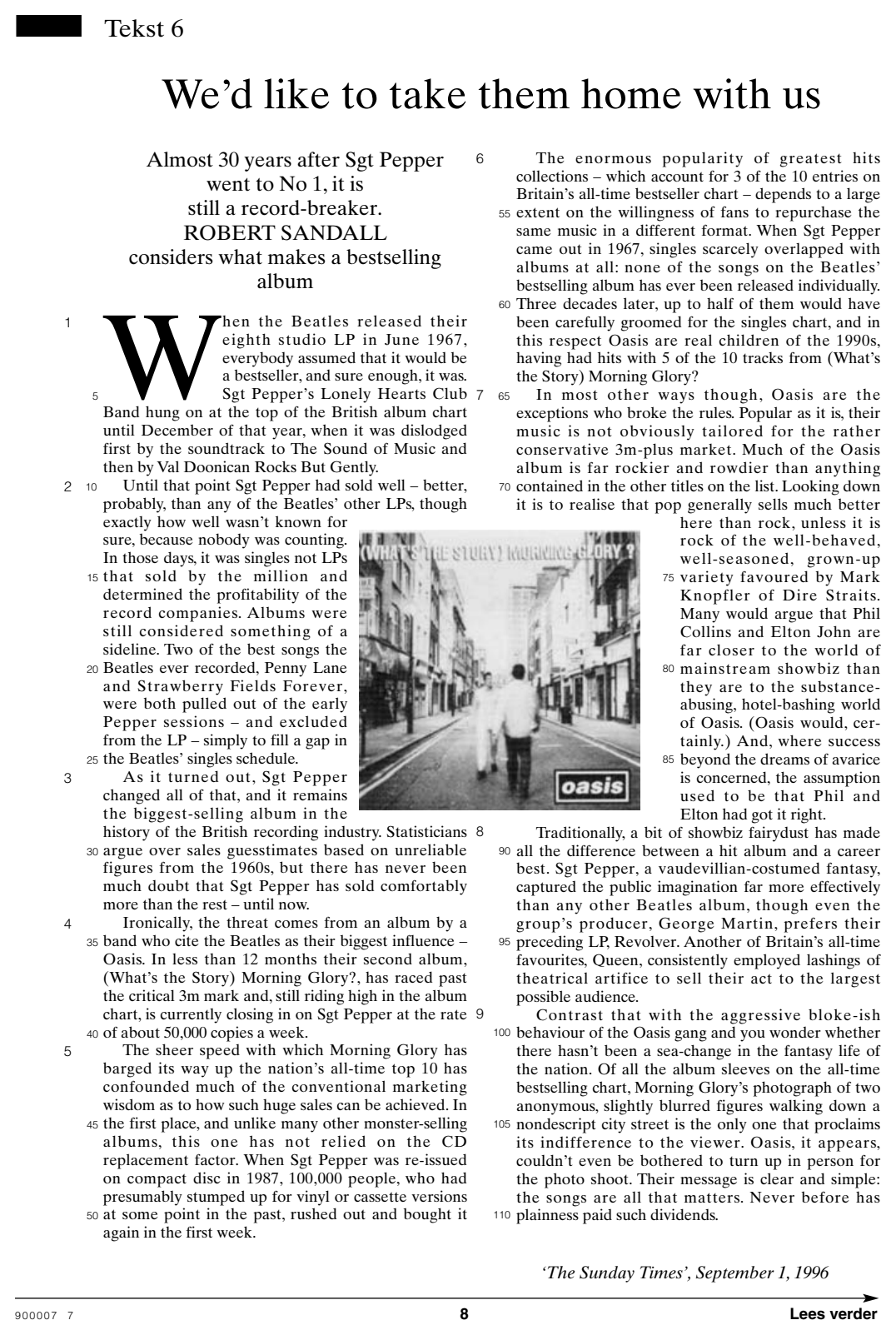
 What conclusion does the writer draw on the basis of the Morning Glory sleeve?
 Oasis do not have any respect for their fans.
 Oasis hate being photographed.
 Oasis have set a new trend in album sleeves.
 Oasis think their music should sell itself.
 What is the main aim of this article?
 To influence the reader’s opinion.
 To inform the reader.
 To spur the reader into action.
 What is the main point made by Michael Ghirelli?
 Britain is not the only nation guilty of colonialism and aggression.
 Britain should express its regret for its behaviour towards Ireland in the past.
 If Britain says sorry to Ireland, Italy should do the same to most of Europe.
 Nations cannot be held responsible for harm caused by past generations.
 Which of the following sentences from Michael Ghirelli’s letter is sarcastic?
 ‘Now … times.’ (lines 14–21)
 ‘Just how far … innocent?’ (lines 28–31)
 ‘In no … parents.’ (lines 42–46)