42
Which three statements are in line with paragraph 1?
1 Dreams enable people to enter a world of miraculous possibilities.
2 Dreams may turn ordinarily unimaginative people into writers.
3 Dreams reflect a person’s character.
4 People’s dreams tend not to be interesting to others.
5 Writers are likely to have special qualities where dreams are concerned.

1, 2 and 3.

1, 4 and 5.

2, 3 and 4.

2, 3 and 5.

3, 4 and 5.
43
How does Nicholas Royle characterise his book, judging from paragraph 2?

It is intended to serve a good cause, and therefore provides only light reading matter.

It is the dream that is central to the book, not textual quality.

It should be regarded as fiction, not as a collection of autobiographical stories.
44
What criticism of Royle’s book does Peter Parker offer in paragraph 2?

A disproportionate number of stories suffer from the influence of the science-fiction genre.

The book includes too many badly written accounts of dreams by unknown writers.

The majority of the book’s contributors lack accuracy when describing their dreams.
45
What does ‘the difficulty’ (paragraph 3) refer to?

Describing the contents of a dream as one remembers it.

Describing the horror characteristic of many dreams.

Explaining the deeper meaning of a dream.

Remembering the exact contents of a dream.
46
What are the examples of the dream stories in paragraph 3 meant to make clear?

Dreams about horrific events are suitable subject matter for stories.

It is possible to turn dreams into worthwhile reading material.

The description of dreams results in fairly unusual stories.
47
Why does Peter Parker call Jack Kerouac’s observation ‘an apt epigraph’ (paragraph 4)?
It is consistent with

the eagerness with which people communicate their dreams.

the fact that people can appreciate pleasant dreams.

the fact that some types of dreams are common to all people.
48
How can Peter Parker’s final judgment of
The Tiger Garden be summed up?

It appeals to people’s taste for mystery and glamour, but lacks logic.

It is fascinating in some ways, but too bizarre to be credible.

It is indefinably attractive, though without much literary value.

It is pretentious, as its contributions are too predictable.
Let op: de laatste vragen van dit examen staan op de volgende pagina.
 Which two reasons does the article supply?
 1 and 2.
 1 and 4.
 2 and 3.
 2 and 4.
 3 and 4.
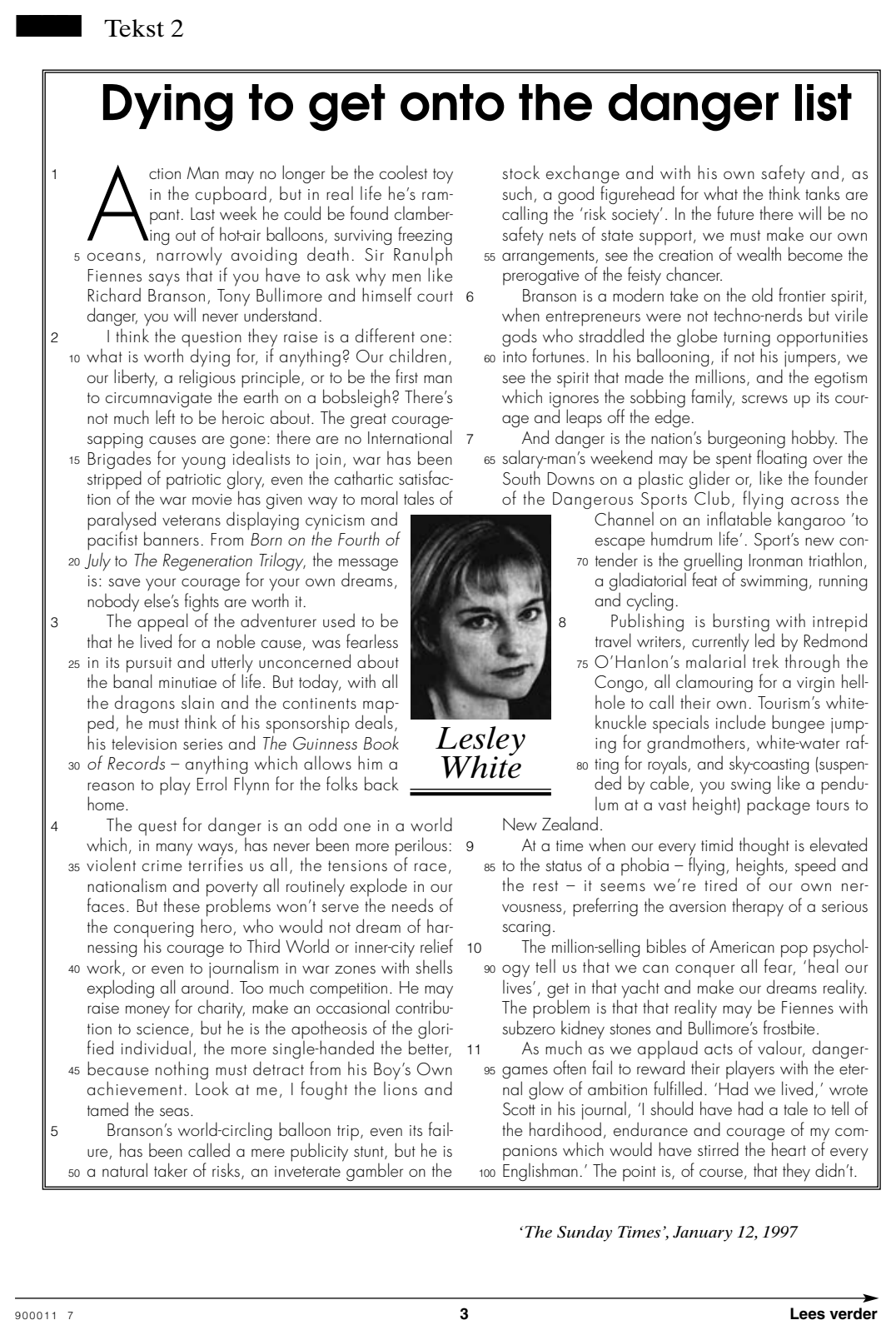
 What is the main point made in paragraph 1?
 Some people are unable to break away from their childhood and to face up to their
 Some people engage in risky undertakings for reasons that seem to lie outside the scope of
 Some people’s ruthless practice of dangerous sports gets an inexplicable amount of publicity.
 Some people will go to any length in order to draw attention to themselves.
 Why is there ‘not much left to be heroic about’ (line 13)?
 Modern-day warfare no longer depends on the heroic commitment of individual soldiers.
 Modern man is too individualistic to pursue common causes.
 There have been no conflicts on a global scale for a long time.
 The spirit of the age has robbed people of common ideals they want to sacrifice
 Which of the following would be a fitting concluding sentence to paragraph 2?
 Bravery, in other words, has become a highly selfish matter.
 Schoolboy bravado, in short, is a thing of the past.
 The modern-day adventurer is, by definition, an unpatriotic figure.
 What is the point made in paragraph 3?
 There are no longer any challenges for the modern hero.
 These days, media coverage of heroic feats has made them seem ordinary.
 Today’s hero’s concerns are worldly and directed at gaining personal glory.
 Which question do lines 33–37 (‘The quest … faces.’) give rise to?
 Is seeking adventure the best way to escape from the world’s misery?
 Must the world be made an even more dangerous place for those living in it?
 Why not stay closer to home when trying to improve the world?
 Why pursue danger in an already turbulent world?
 Why is it that ‘these problems won’t serve the needs of the conquering hero’ (lines 37–38),
 Dealing with them is an unrewarding task because of their overwhelming size.
 Devoting himself to them does not give him the recognition he is looking for.
 Tackling them would not result in the financial rewards that come with real adventures.
 How can the writer’s view on Branson be summed up (paragraphs 5 and 6)?
 He is living proof that wealthy persons do not contribute to the fabric of society.
 His dare-devil vigour goes against the spirit of the age.
 His eccentric exploits catch the eye, but can hardly be taken seriously.
 His adventurer’s spirit may be considered a pointer to the way society will develop.
 What phenomenon is described in paragraphs 7 and 8?
 All sorts of people are prepared to go to extremes just for the thrill of it.
 At every level of society people tend to spend their leisure time farther away from home.
 In order to solve their problems, people are willing to risk their lives.
 Which of the following are in line with the writer’s view as expressed in paragraphs 9
 1 and 2.
 1 and 3.
 2 and 3.
 2 and 4
 3 and 4.
 What is made clear in paragraph 11?
 Acts of self-sacrifice more often than not end in human tragedy.
 Adventurers may not live to savour the glory they had hoped to achieve.
 Experiencing adventures is often less thrilling than looking forward to them.
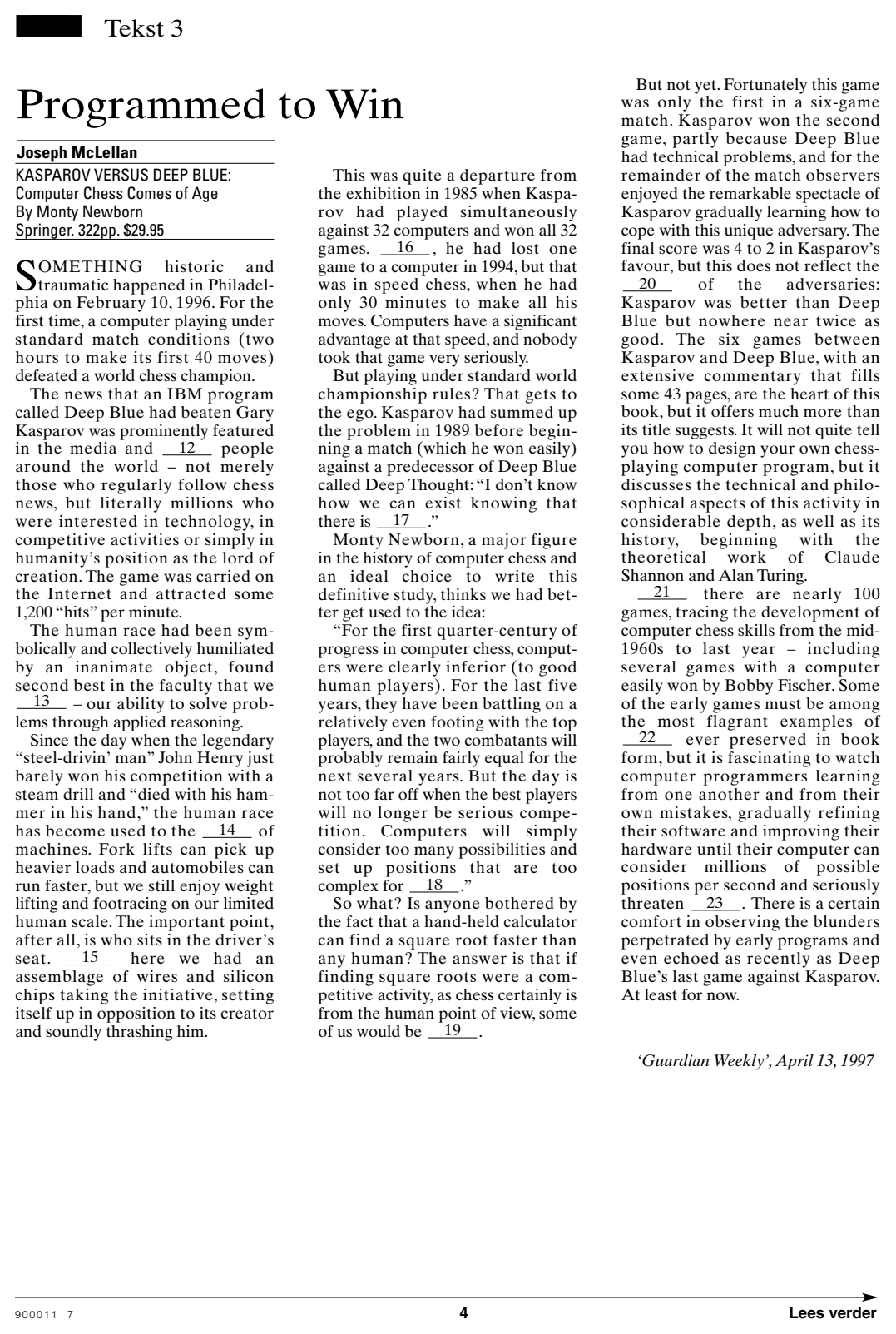
 delighted
 electrified
 informed
 dare not always rely on
 prize most dearly
 tend to underestimate
 would hate to lose
 basic inadequacy
 diminishing importance
 increasing complexity
 physical superiority
 Besides,
 For
 However,
 So
 Consequently
 Moreover
 True
 Typically
 no limit to human ability
 no room anymore for chess as a mere game
 something mentally stronger than us
 something technological trying to cheat us
 any but the top players
 even software designers
 mere mortals
 words
 more than surprised
 overjoyed
 quite indifferent
 seriously disturbed
 continuous interaction
 degree of flexibility
 difference in tactics
 relative playing strength
 Conversely,
 Even so,
 In addition,
 Rather,
 So
 chess blindness
 human arrogance
 technological complexity
 further developments in the field
 humanity’s self-esteem
 the competitive character of chess
 the value of amateur chess
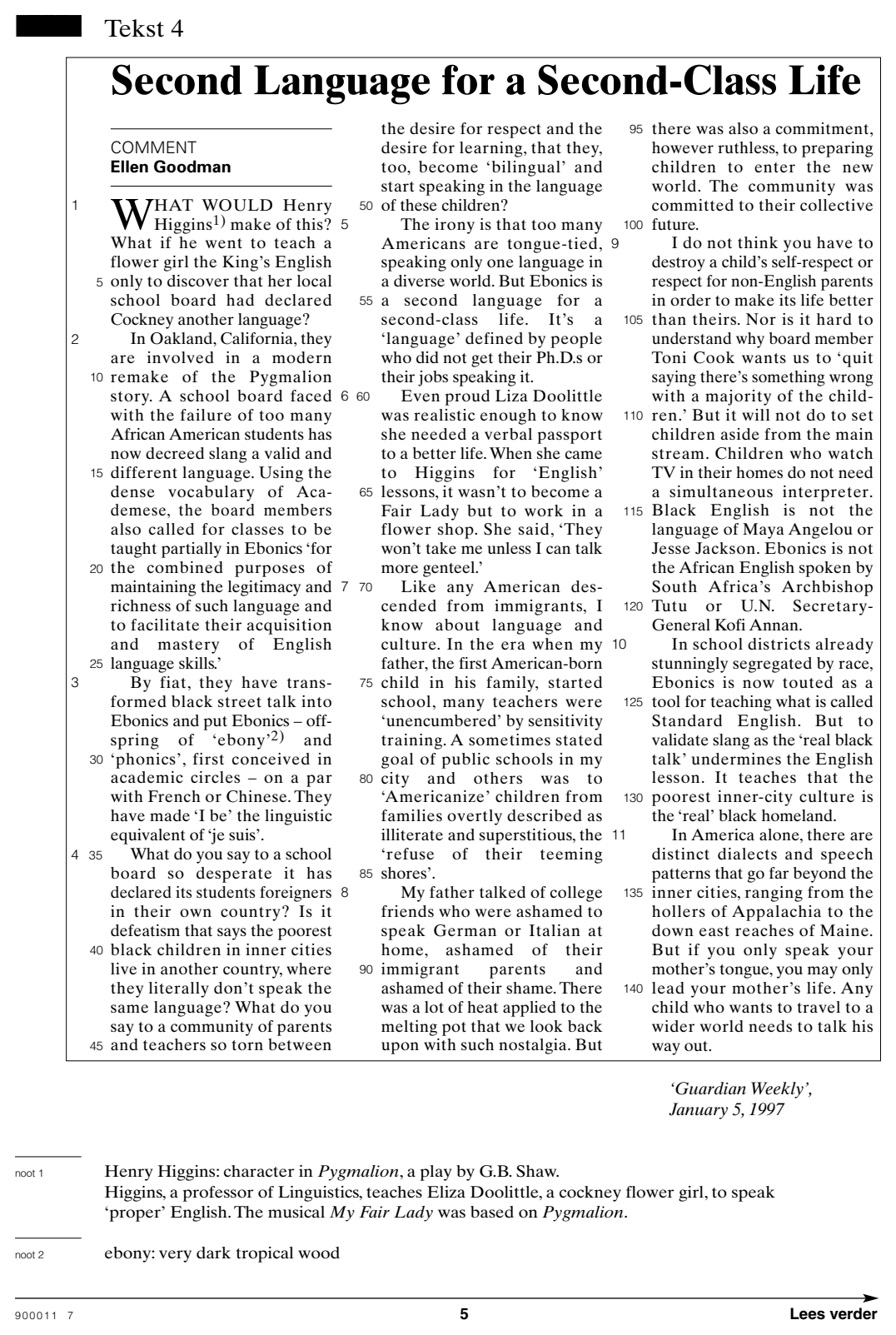
 Which of the following does Ellen Goodman want to make clear by referring to
 Her doubt about the effectiveness of two languages being taught simultaneously.
 Her optimism about the benefits of extra language tuition for African American students.
 Her regret at African Americans’ inability to speak standard English.
 Her reservations about the decision to allow Ebonics as a medium of instruction.
 Why does the writer add ‘They have … “je suis”.’ (lines 32–34)?
 To refute the assumption that Ebonics is easy to learn.
 To ridicule the thought that Ebonics would qualify as a language in its own right.
 To show that Ebonics is just as suitable for communication as French.
 To suggest that Ebonics is not as hard to learn as French.
 What are the questions in paragraph 4 meant to make clear?
 Education has become a breeding ground of discrimination.
 Schools and parents have conflicting interests where the language of instruction is
 Teaching in both Ebonics and English should get priority.
 The situation of many black children is very worrying indeed.
 Which of the following could be added to ‘The irony’ in line 51?
 of this failure of education
 of this lack of communication
 of this so-called bilingualism
 of this supposedly new form of American English
 Who are the ‘people’ mentioned in line 57?
 People in ivory towers.
 The Oakland schoolboard members.
 Those who use both Ebonics and English.
 What is the point made by the reference to Liza Doolittle (line 60)?
 Most people are motivated to speak another language by their wish to rise on the social
 Speaking politely is a requirement for people both in higher and lower positions.
 The ability to speak English opens doors all over the world.
 The use of substandard language is an obstacle to social improvement.
 How can paragraphs 7 and 8 be summed up?
 American immigrants very much aspired to get a good education for themselves.
 American immigrants were in favour of a multi-cultural education for their children.
 integration into American society was compulsory and considered necessary for every
 newly arrived immigrants found that American education was of little use to them.
 Which view does Ellen Goodman support, according to lines 101–110 (‘I do … children.”’)?
 Children should not be made to feel inferior because of the language they speak.
 Children who linguistically are at a disadvantage should not be given preferential treatment.
 Ebonics should not be looked upon as a second-class language.
 Which of the following reflects the idea expressed in paragraph 10?
 According to linguistic criteria, Ebonics is unacceptable.
 Teaching in Ebonics will be useful to black people only.
 Teaching in Ebonics will give black children an even greater sense of isolation.
 Which of the following is true of the last paragraph?
 It invites young Americans to discover the rest of the world.
 It points to the desirability of understanding various American dialects.
 It suggests that dialects are bound to become extinct.
 It underlines the necessity of being able to speak the standard language.
 What is the point made in paragraph 1?
 Crimes not only damage the victims, they also affect those committing them.
 Society seems to put the prosecution of criminals before the interests of the victims of crime.
 Victims of crime and victims of wrongful prosecution suffer in similar ways.
 How does paragraph 2 relate to paragraph 1?
 It draws a conclusion from the point made in paragraph 1.
 It elaborates the point made in paragraph 1.
 It narrows down the point made in paragraph 1.
 It questions the validity of the point made in paragraph 1.
 Which word could be inserted between ‘will’ and ‘shield’ (lines 23–24)?
 at least
 even
 nonetheless
 thus
 Who are meant by ‘the former’ (line 35)?
 Criminals to whom the law fails to be applied.
 Innocent people who are convicted.
 Politicians of the Left.
 Those working in the criminal-justice system.
 What does paragraph 5 make clear about David Rose with regard to his proposals for
 He acknowledges they are too idealistic to ever be put into practice.
 He admits they are less convincing than his analysis of the justice system.
 He is confident that in due course they will be accepted as solutions.
 He is not optimistic about their being implemented in the near future.
 Why does the writer call the four truths about the criminal-justice system ‘uncomfortable’
 can never be free of inherent failings and disturbing influences.
 cannot contribute to a socially and politically sound society.
 is subject to change whenever the political situation calls for it.
 is too dependent on people’s unconditionally adhering to the law.
 What is the main point made about David Rose in paragraph 8?
 he places personal experience in the context of an era.
 he uses the genre of fiction to reveal social wrongs.
 he writes vividly, linking the specific to the general.
 he writes with precision, making the unbelievable acceptable.
 Which conclusion is in line with the last paragraph?
 fears that the criminal-justice system is at the mercy of uncooperative and corrupt police
 feels the government should work on the conditions causing the criminal-justice system to
 makes clear that crime will only decrease if the criminal-justice system is improved.
 thinks a change of government is needed to get the criminal-justice system to function
 What is the point of discussion in the debate mentioned in the first paragraph?
 abortion should be made legal.
 foetuses with known handicaps should be aborted.
 people with a hereditary disease should become parents.
 Siamese twins should be separated at birth.
 Which sentence reflects the Observer’s stand on the debate discussed in the editorial?
 ‘The definition … mortality.’ (third paragraph)
 ‘A government-sponsored … with them.’ (last paragraph)
 ‘For that … arbiter.’ (last paragraph)
 ‘But ambiguity … our times.’ (last paragraph)